




Beauty industries rarely change overnight.
They evolve quietly, shaped by cultures, consumer habits and ideas that often go unnoticed until the rest of the world begins to imitate them. By the time a trend reaches international shelves, it is usually no longer a trend where it began—it has become part of everyday life.
That is perhaps the clearest way to understand Korean skincare.
Long before “glass skin” became a social media aspiration or Korean serums found their place in luxury department stores from London to Dubai, skincare occupied a different role in South Korea. It was less about transformation than maintenance; less about correcting flaws than preserving health. Caring for the skin was treated as a daily practice, woven into routines with the same consistency as brushing one’s teeth rather than reserved for moments of concern.
The global beauty industry eventually took notice.
What followed was more than the success of a handful of brands. Korean beauty reshaped the language of modern skincare. It changed how products were formulated, how consumers evaluated ingredients and, perhaps most importantly, what healthy skin came to represent.
Today, terms such as skin barrier, double cleansing and Centella Asiatica have entered the mainstream vocabulary of beauty enthusiasts across continents. Luxury houses that once defined skincare through heritage increasingly speak the language of hydration, microbiome health and preventative care—principles that Korean brands had been refining for years.
The enduring influence of K-Beauty has little to do with novelty.
It stems from a philosophy that continues to feel remarkably modern: healthy skin is rarely the result of dramatic intervention. More often, it is the product of thoughtful choices repeated consistently over time.
What Is Korean Skincare?
Korean skincare, commonly known as K-Beauty, is often mistaken for a routine.
In reality, it is a philosophy of skin health.
While the number of products associated with Korean beauty has attracted considerable attention, the routine itself has never been the defining feature. The true distinction lies in how Korean skincare approaches the skin—not as something to perfect, but as a living barrier that deserves daily support.
This perspective has shaped an industry recognised for balancing cosmetic innovation with practicality. Products are typically designed to work in harmony rather than isolation, allowing consumers to build routines that address individual concerns without overwhelming the skin.
It is an approach that reflects broader shifts within South Korean society.
The country’s beauty market is among the most sophisticated and competitive in the world, where consumers are highly informed and quick to adopt scientific developments. Brands are expected not only to launch new products, but to improve formulations continuously, respond to emerging research and deliver visible results without compromising comfort.
That environment has encouraged a level of innovation that extends far beyond packaging or marketing. It has fostered an ecosystem where cosmetic chemists, dermatologists and consumers influence one another, accelerating product development at a pace few markets can match.
For international audiences, the appeal is clear. Korean skincare offers a vision of beauty that feels increasingly aligned with contemporary dermatology: protect first, repair when necessary and recognise that consistency almost always outperforms intensity.
Why Korean Beauty Changed the Global Beauty Industry
Few beauty movements have altered consumer behaviour as profoundly as K-Beauty.
Its influence reaches far beyond the popularity of individual products. It has fundamentally changed what consumers expect from skincare itself.
Innovation Driven by Everyday Consumers
In many markets, innovation begins inside corporate laboratories before gradually filtering into everyday routines.
South Korea has long operated differently.
Its beauty industry is characterised by exceptionally engaged consumers who scrutinise ingredients, compare formulations and expect frequent improvements. Their expectations have helped create one of the fastest product development cycles in the global cosmetics industry, where brands must innovate continuously to remain relevant.
This relationship between consumer demand and scientific development has produced ideas that have since become global standards rather than regional curiosities.
Cushion foundations, sleeping masks, lightweight sunscreens and hydrogel patches are only a few examples of concepts that travelled well beyond Seoul after proving their value at home.
A Different Relationship with Ingredients
Perhaps the most significant contribution of Korean skincare has been its treatment of ingredients.
Rather than presenting active ingredients as miracle solutions, Korean formulations often focus on how ingredients interact with one another and with the skin’s natural functions.
This distinction is subtle but important.
Centella Asiatica is valued not because it is fashionable, but because of its soothing properties. Ceramides are appreciated for supporting the skin’s protective barrier. Hyaluronic acid is incorporated to maintain hydration across different layers of the skin, while fermented extracts are frequently used to improve texture and support absorption.
The emphasis is rarely on finding a single “hero” ingredient.
Instead, the objective is balance.
That philosophy has become increasingly influential as consumers move away from aggressive skincare routines towards formulations that respect the skin’s long-term health.
The Luxury Industry Took Notice
For decades, luxury skincare was largely shaped by European heritage houses whose narratives centred on exclusivity, craftsmanship and scientific prestige.
K-Beauty introduced a different form of luxury.
Innovation became accessible rather than aspirational. Elegant formulation mattered more than elaborate branding. A product’s texture, ingredient list and user experience often carried greater weight than its price point.
The result was not the replacement of traditional luxury skincare, but its evolution.
Many international brands now invest more heavily in lightweight textures, barrier-supporting formulations and hydration-focused routines that reflect principles long embedded within Korean beauty. The influence is visible not because brands openly imitate Korea, but because the industry’s priorities have gradually shifted in the same direction.
True leadership rarely announces itself.
It becomes visible when everyone else begins following the same path.
The Philosophy Behind Korean Skincare
The popularity of Korean skincare has occasionally obscured its greatest strength.
People often discuss the products.
Far fewer discuss the philosophy.
Yet it is this philosophy—not any single serum or moisturiser—that explains why K-Beauty has remained influential while countless beauty trends have faded.
Prevention Before Correction
Modern skincare conversations often revolve around solving problems once they become visible: pigmentation, dehydration, irritation or premature signs of ageing.
Korean skincare asks a quieter question.
What if many of those concerns could be reduced before they appeared?
Daily sunscreen, gentle cleansing, consistent hydration and barrier support are not presented as extraordinary interventions. They are treated as habits capable of preserving the skin’s natural resilience over time, reflecting guidance from leading dermatology organisations.
Increasingly, dermatologists around the world echo this perspective. Preventative care is rarely dramatic, but it often proves more effective than repeatedly addressing damage after it has occurred.
Healthy Skin Begins with the Barrier
Few concepts have reshaped skincare discussions more profoundly in recent years than the skin barrier.
The outermost layer of the skin regulates moisture, limits water loss and protects against environmental stressors. When compromised, the consequences often extend beyond dryness, contributing to irritation, sensitivity and inflammation.
Long before “barrier repair” became a global marketing phrase, Korean formulations consistently prioritised ingredients that helped reinforce this protective function.
Ceramides, panthenol, Centella Asiatica and nourishing moisturisers became staples not because they promised dramatic transformation, but because they supported the skin’s ability to perform the work it was already designed to do.
There is a quiet confidence in that approach.
Rather than asking the skin to become something different, it helps the skin become stronger at being itself.
Consistency Is the Most Underrated Ingredient
The beauty industry often rewards immediacy.
Consumers are encouraged to expect visible change within days, while new launches promise increasingly dramatic results.
Korean skincare moves at a different pace.
It recognises that healthy skin is cumulative. Every gentle cleanse, every application of sunscreen and every layer of hydration contributes incrementally to outcomes that may only become visible months later.
In that sense, Korean skincare reflects a broader philosophy that extends beyond beauty.
Lasting change is rarely built through intensity.
It is built through consistency.
That may be the most enduring lesson K-Beauty has offered the world. Its greatest innovation is not a single ingredient, a viral product or a multi-step routine. It is the reminder that caring for the skin is less about pursuing perfection than cultivating health—patiently, deliberately and with the understanding that the smallest daily rituals often leave the deepest, most lasting impression.
The Essential Korean Skincare Routine
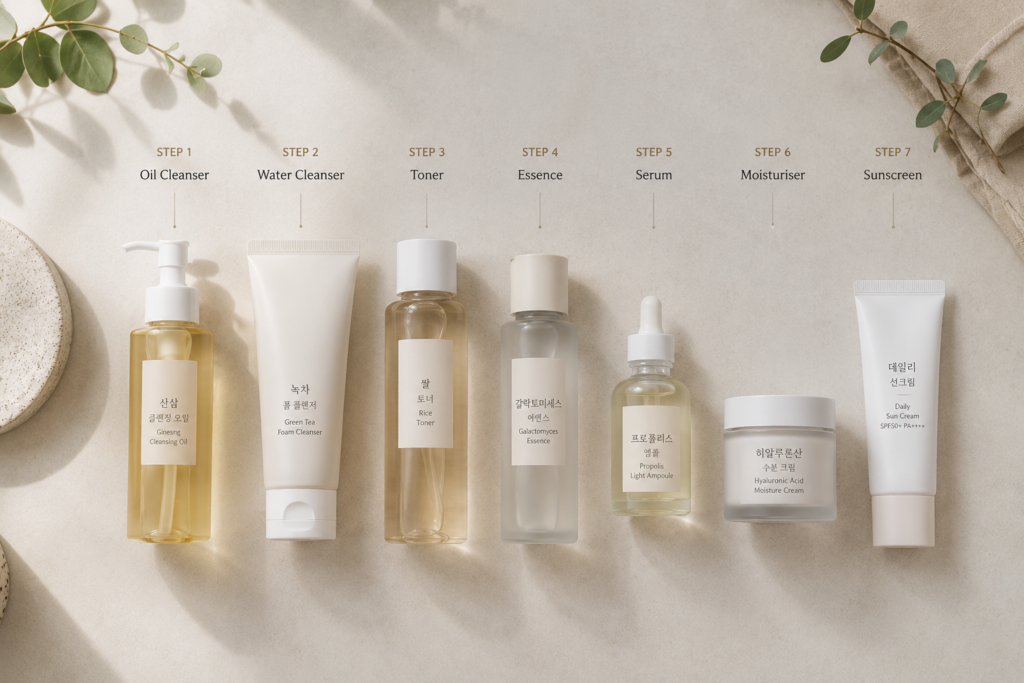
The famous “10-step Korean skincare routine” has become one of K-Beauty’s most recognisable exports. It has also become one of its most misunderstood.
For many newcomers, the routine appears overwhelming—a carefully choreographed sequence requiring countless bottles and an unrealistic amount of time. In reality, most Koreans do not follow ten steps every morning and evening. Much like wardrobes adapt to seasons, skincare routines evolve according to the skin’s changing needs, the climate and individual concerns.
The routine was never intended to be a rigid formula.
It is better understood as a flexible framework that encourages thoughtful layering, allowing each product to perform a specific role without overwhelming the skin. Some days may require only four carefully chosen products. Others may benefit from additional hydration or targeted treatments.
The philosophy remains remarkably simple: cleanse gently, hydrate consistently, protect daily and introduce active ingredients with intention rather than excess.
Oil Cleanser: Removing What Water Cannot
Healthy skin begins with effective cleansing, but Korean skincare distinguishes between removing impurities and stripping the skin.
An oil cleanser is designed to dissolve sunscreen, makeup, excess sebum and oil-based pollutants that accumulate throughout the day. Because like dissolves like, cleansing oils lift these impurities without the harsh friction that can accompany repeated washing.
This first step is especially valuable for anyone who wears sunscreen daily—which dermatologists universally recommend—or lives in cities where pollution can leave residue on the skin.
Contrary to a common misconception, oil cleansers are not reserved for dry skin. Many formulations emulsify upon contact with water, rinsing away cleanly and leaving oily or combination skin feeling balanced rather than greasy.
Water-Based Cleanser: Refreshing Without Disruption
The second cleanse removes sweat, water-soluble debris and any remaining residue left behind after the oil cleanse.
Korean cleansers are typically formulated with a lower pH than traditional foaming cleansers, helping maintain the skin’s natural acid mantle rather than disrupting it. This seemingly small detail reflects a broader K-Beauty principle: cleansing should prepare the skin for the rest of the routine, not compromise its barrier before treatment has even begun.
The sensation after cleansing is telling.
Skin should feel clean, comfortable and refreshed—not tight or squeaky.
If cleansing leaves the face feeling stripped, the routine has already moved away from one of Korean skincare’s central philosophies.
Toner: Restoring Balance, Not Removing Dirt
For years, toners carried an unfortunate reputation.
Many Western formulations were alcohol-based and designed to remove traces of makeup left behind after cleansing. Korean toners serve an entirely different purpose.
Rather than acting as a final cleanser, they replenish hydration immediately after washing, helping prepare the skin to absorb subsequent products more effectively.
Modern Korean toners often contain soothing botanical extracts, amino acids or humectants that soften the skin while reducing the feeling of dehydration that can follow cleansing.
The difference is subtle, yet transformative.
A toner should leave the skin feeling replenished—not challenged.
Essence: The Quiet Innovation of K-Beauty
Few products illustrate Korean skincare’s influence more clearly than the essence.
When essences first appeared outside Asia, they puzzled many consumers. They seemed too lightweight to be serums yet more purposeful than toners.
Today, countless international brands have introduced their own versions.
An essence is designed to deliver lightweight hydration while supporting skin renewal through carefully selected active ingredients or fermented extracts. Rather than producing dramatic overnight results, it gradually improves how the skin retains moisture and responds to subsequent treatments.
Its impact is often cumulative.
Like many aspects of Korean skincare, its value becomes most apparent through consistency rather than immediacy.
Serum: Targeted Care with Purpose
If the routine has a specialist, it is the serum.
Serums deliver concentrated ingredients chosen to address specific concerns, whether uneven pigmentation, dehydration, dullness or the first visible signs of ageing.
The Korean approach, however, differs from the pursuit of increasingly powerful formulations.
Instead of encouraging consumers to combine numerous potent actives simultaneously, many Korean brands prioritise ingredients that complement one another while remaining gentle enough for regular use.
This philosophy helps explain the popularity of ingredients such as niacinamide, Centella Asiatica and hyaluronic acid, which offer meaningful benefits across a wide range of skin types without unnecessarily increasing the risk of irritation.
Moisturiser: Supporting the Skin Barrier
Hydration and moisturisation are often spoken about interchangeably, yet Korean skincare treats them as two distinct stages.
Hydrating products draw water into the skin.
Moisturisers help keep it there.
A well-formulated moisturiser strengthens the skin barrier by reducing transepidermal water loss, allowing previous layers to remain effective for longer. Korean moisturisers frequently achieve this through elegant textures that feel nourishing without becoming heavy, making them suitable across different climates—including the intense heat experienced throughout much of the Middle East.
Healthy skin rarely depends on one exceptional product.
It depends on each layer supporting the next.
Sunscreen: The Most Important Step
No product better reflects the preventative philosophy of Korean skincare than sunscreen.
Daily sun protection is not presented as an optional final touch reserved for summer holidays. It is treated as the single most effective long-term investment in skin health.
Ultraviolet radiation remains one of the leading contributors to premature skin ageing, uneven pigmentation and collagen breakdown. Consistent sunscreen use therefore protects not only against immediate sun exposure but against cumulative damage that develops gradually over years.
Korean sunscreens have earned international recognition for another reason as well.
Their lightweight textures, comfortable finishes and elegant formulations have helped change consumer expectations of what sunscreen should feel like. Products that once felt thick or difficult to wear every day have increasingly been replaced by formulas that integrate seamlessly into daily routines.
Perhaps this is why sunscreen occupies such an important place within K-Beauty.
It is not the final step because it matters least.
It comes last because it protects everything that came before it.
Ingredients That Define K-Beauty
Every generation of skincare has its defining ingredients.
Vitamin C reshaped conversations around brightening. Retinoids transformed approaches to healthy ageing. Peptides introduced new possibilities for supporting collagen production.
Korean skincare has not replaced these ingredients.
It has broadened the conversation by introducing formulations that place equal importance on soothing, hydration and barrier resilience.
Rather than searching endlessly for a single miracle ingredient, K-Beauty encourages understanding how different ingredients work together to support healthier skin over time.
Snail Mucin: The Ingredient That Changed Perceptions
Few ingredients have generated as much curiosity as snail mucin.
Initially met with scepticism outside Asia, it has become one of Korean skincare’s most recognisable innovations.
Snail secretion filtrate is valued for its ability to support hydration while helping improve the appearance of skin recovering from irritation or post-inflammatory marks. Rich in naturally occurring glycoproteins and humectants, it contributes to a smoother, more resilient complexion without feeling occlusive.
Its popularity reflects a recurring theme within Korean skincare: unusual ingredients gain acceptance not through novelty alone, but because consistent results gradually outweigh initial hesitation.
Centella Asiatica: The Barrier Builder
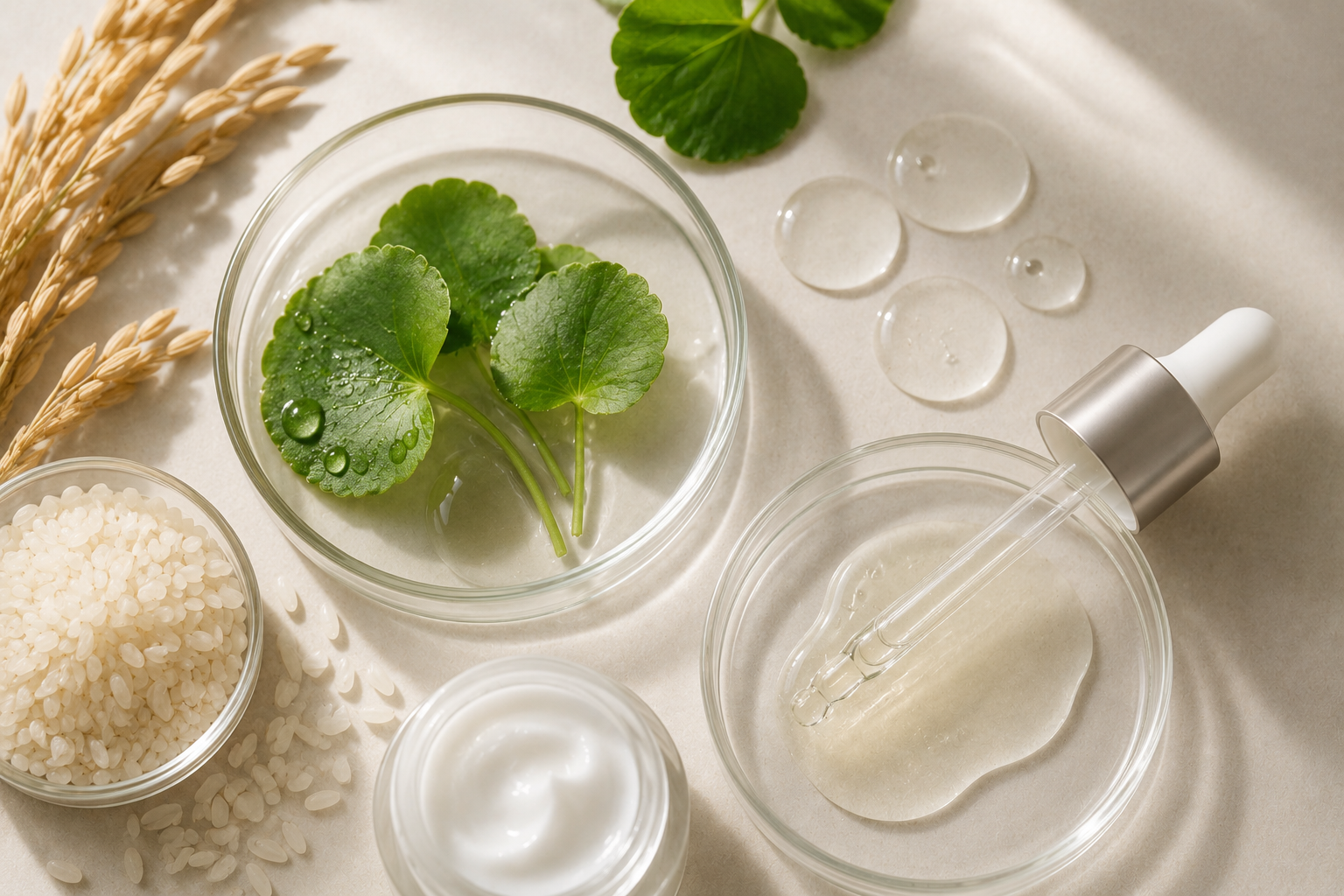
Known in Korea as Cica, Centella Asiatica has become synonymous with calming sensitive skin.
Long used in traditional herbal medicine, it is now widely recognised for helping reduce visible redness while supporting the skin’s natural repair processes.
For individuals navigating sensitivity, environmental stress or over-exfoliation, Centella often serves as one of the most reliable ingredients for restoring comfort without introducing unnecessary complexity.
Its growing popularity worldwide mirrors the industry’s increasing appreciation for barrier-focused skincare.
Niacinamide: Quietly Versatile
Few ingredients demonstrate versatility as effectively as niacinamide.
A form of vitamin B3, it is widely used to help regulate excess oil, improve uneven skin tone, strengthen the skin barrier and reduce the appearance of enlarged pores.
Its greatest strength lies not in dramatic transformation but in adaptability.
Because it complements many other skincare ingredients, niacinamide has become a cornerstone of Korean formulations designed for long-term use rather than rapid intervention.
Rice Extract: Tradition Meets Modern Formulation
Rice has held cultural significance across East Asia for centuries, long before cosmetic laboratories began studying its skincare benefits.
Today, rice extract is commonly incorporated into Korean formulations for its brightening, antioxidant and hydrating properties.
Its presence illustrates one of K-Beauty’s defining characteristics: traditional botanical knowledge is often revisited through contemporary cosmetic science rather than preserved as folklore alone.
Heartleaf: Calming Modern Skin
As urban lifestyles expose skin to pollution, stress and environmental aggressors, soothing ingredients have become increasingly valuable.
Heartleaf, derived from Houttuynia cordata, has emerged as one of Korean skincare’s preferred botanical extracts for calming visible irritation while helping maintain balance in acne-prone or reactive skin.
Its growing popularity reflects changing consumer priorities.
Healthy skin is no longer measured solely by brightness or smoothness, but by resilience.
Ceramides: Reinforcing the Skin’s Natural Defences
Ceramides are naturally occurring lipids found within the skin barrier.
When levels decline through ageing, environmental exposure or excessive exfoliation, moisture escapes more easily and sensitivity often increases.
Korean moisturisers and barrier creams frequently incorporate ceramides to reinforce this protective structure, supporting healthier skin without relying on harsh intervention.
The objective is not simply to repair damaged skin.
It is to help prevent that damage from occurring in the first place.
Hyaluronic Acid: Hydration Without Weight
Despite its scientific name, hyaluronic acid is one of skincare’s gentlest ingredients.
Its ability to attract and retain water makes it particularly valuable in climates where air conditioning, low humidity or prolonged sun exposure can gradually dehydrate the skin.
Korean formulations often combine multiple molecular weights of hyaluronic acid, allowing hydration to reach different layers of the skin while maintaining the lightweight textures that have become synonymous with K-Beauty.
The result is skin that feels comfortably hydrated rather than coated.
Common Myths About Korean Skincare
As Korean skincare has become more mainstream, so too have misconceptions surrounding it.
Many stem from social media, where simplified routines and viral products often overshadow the philosophy that gives K-Beauty its lasting value.
Myth 1: Everyone Needs a 10-Step Routine
Perhaps the most persistent misconception is that Korean skincare requires ten products every day.
In reality, routines are highly individual. A gentle cleanser, moisturiser and sunscreen may be sufficient for one person, while another may choose to incorporate targeted serums or additional hydration depending on seasonal changes or specific concerns.
The number of products has never been the goal.
Healthy skin is.
Myth 2: Korean Skincare Is Only for Young People
Although younger consumers helped popularise K-Beauty internationally, its philosophy is relevant at every stage of life.
Barrier support, hydration and sun protection remain essential regardless of age, making Korean skincare equally valuable for mature skin seeking long-term resilience.
Myth 3: It Doesn’t Work for Middle Eastern Skin
Skin physiology is remarkably consistent across ethnicities.
What differs is climate, lifestyle and individual skin concerns.
Many Korean formulations—particularly lightweight moisturisers, soothing ingredients and elegant sunscreens—perform exceptionally well in warmer climates, making them well suited to consumers throughout the GCC when selected thoughtfully.
Myth 4: More Products Mean Better Results
Perhaps the greatest misunderstanding of all.
Korean skincare has never encouraged excess.
Its philosophy favours choosing the right products, introducing them gradually and allowing consistency—not complexity—to shape healthier skin.
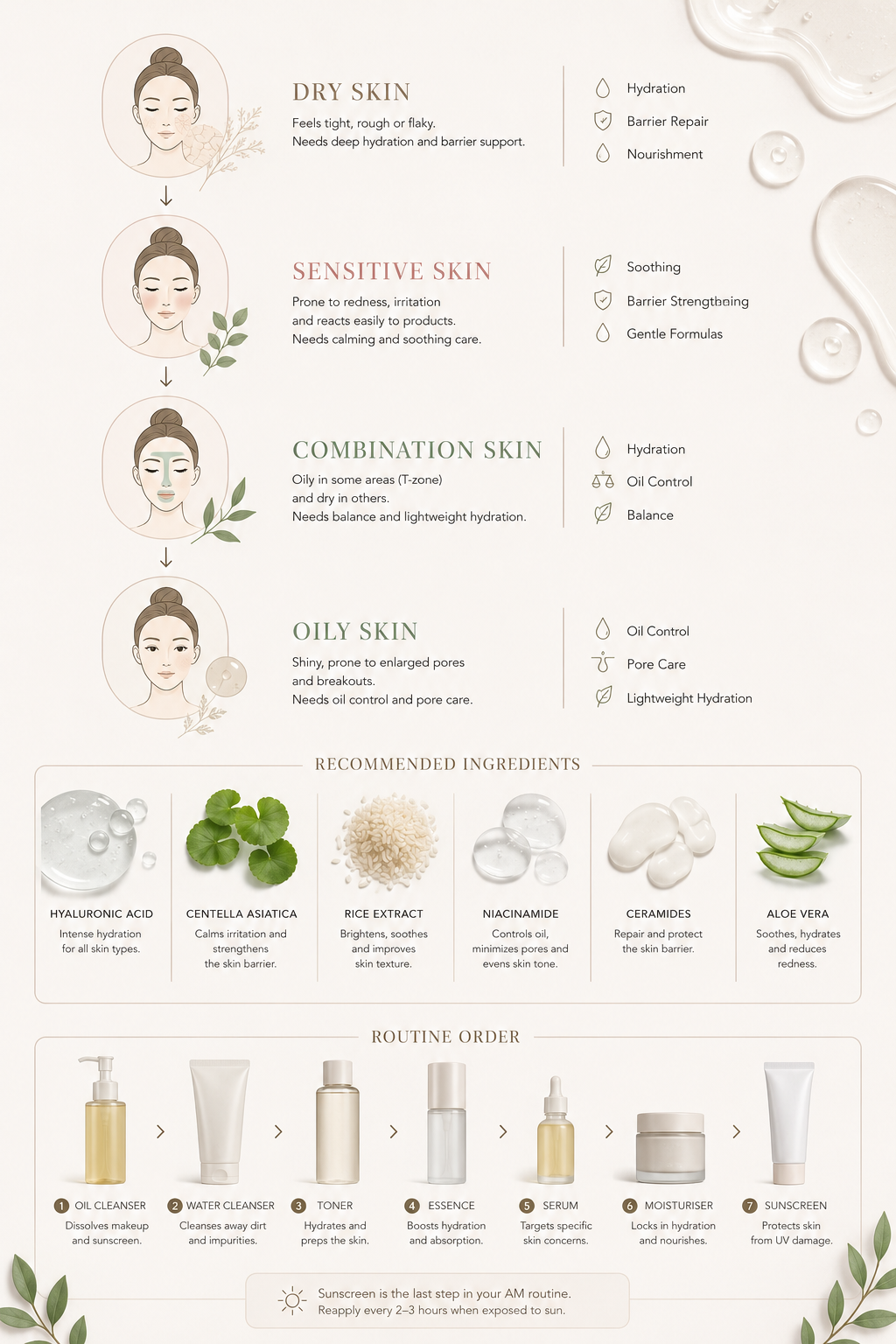
How to Build a Korean Skincare Routine for Your Skin Type
One of the reasons Korean skincare has travelled so successfully across cultures is its flexibility.
Rather than prescribing a universal routine, K-Beauty encourages people to understand how their skin behaves before deciding what it needs. Two people can use entirely different routines while following the same philosophy: support the skin, avoid unnecessary irritation and remain consistent.
The goal is not to own more products.
It is to choose better ones.
Dry Skin
Dry skin often reflects a weakened barrier that struggles to retain moisture throughout the day.
A Korean routine for dry skin should prioritise hydration at multiple levels before sealing it in with nourishing moisturisers. Gentle cream cleansers, hydrating toners, essences rich in humectants and moisturisers containing ceramides or squalane can help restore comfort without leaving the skin feeling heavy.
Rather than exfoliating frequently, dry skin generally benefits more from strengthening the barrier first. Once hydration improves, the complexion often appears smoother and more radiant naturally.
Oily Skin
One of the most persistent misconceptions is that oily skin needs stronger cleansers and fewer moisturisers.
In many cases, the opposite is true.
Over-cleansing can encourage the skin to compensate by producing even more oil. Korean skincare instead focuses on maintaining balance through lightweight hydration, non-comedogenic moisturisers and ingredients such as niacinamide that help regulate excess sebum while supporting the skin barrier.
Hydrated skin is not necessarily oily skin.
Often, it is healthier skin.
Sensitive Skin
Sensitive skin responds best to simplicity.
Introducing multiple active ingredients simultaneously may create more problems than it solves. Korean skincare’s emphasis on calming formulations makes it particularly well suited to sensitive complexions.
Products containing Centella Asiatica, panthenol, ceramides and heartleaf can help reduce visible irritation while reinforcing the skin’s natural defences. New products should always be introduced gradually, allowing the skin time to adapt before adding another active ingredient.
Patience remains one of the most effective treatments sensitive skin can receive.
Combination Skin
Combination skin requires observation rather than uniform treatment.
The T-zone may produce excess oil while the cheeks experience dehydration, making a one-size-fits-all routine less effective.
Layering becomes especially valuable here. Lightweight hydrating products can be applied across the entire face, while richer moisturisers or targeted treatments are reserved for areas that need additional support.
Rather than forcing the skin into one category, Korean skincare encourages responding to its changing needs with flexibility.
How Korean Beauty Is Influencing Luxury Skincare Worldwide
The influence of Korean skincare is no longer measured by export figures alone.
It can be seen in the language of beauty itself.
A decade ago, conversations centred on anti-ageing, correction and increasingly powerful active ingredients. Today, luxury skincare speaks just as often about hydration, barrier repair, microbiome health and skin resilience—concepts that have long formed the foundation of Korean beauty.
This shift reflects changing consumer priorities as much as scientific progress.
Modern beauty consumers are more informed than previous generations. Ingredient lists are scrutinised, formulations are compared online and purchasing decisions are increasingly influenced by dermatologists, cosmetic chemists and evidence-based education rather than advertising alone.
Korean brands were particularly well positioned for this transition.
Companies such as COSRX, Laneige, Beauty of Joseon, Dr. Jart+ and Sulwhasoo built reputations around transparent ingredients, elegant formulations and accessible innovation rather than relying solely on heritage.
At the same time, luxury beauty houses have increasingly embraced lighter textures, sophisticated sunscreen formulations and barrier-focused products that echo principles Korean skincare has refined for years.
The conversation has evolved from East versus West.
Instead, the global beauty industry has entered a period of shared influence, where ideas travel more freely than ever before.
That exchange benefits consumers most of all.
The result is a broader understanding that healthy skin depends less on geography than on thoughtful formulation, consistent habits and a growing respect for skin biology.
Frequently Asked Questions
Does Korean skincare really work?
Korean skincare is not successful because it follows a secret formula. Its effectiveness comes from combining well-researched ingredients with a preventative philosophy that emphasises hydration, barrier support and consistent daily care. Results depend on choosing products suited to your skin type and using them regularly over time.
Is the 10-step Korean skincare routine necessary?
No. The famous 10-step routine represents a flexible framework rather than a rule. Many people follow routines with four to six products, adjusting them according to their skin’s needs, the season and their lifestyle. Consistency is far more important than the number of steps.
Which Korean skincare ingredients are best for beginners?
Beginners generally benefit from gentle, versatile ingredients such as hyaluronic acid for hydration, niacinamide for balancing oil and improving skin tone, Centella Asiatica for calming sensitivity and ceramides for strengthening the skin barrier. Introducing one new ingredient at a time allows the skin to adapt gradually.
Can Korean skincare work for Middle Eastern climates?
Yes. Many Korean formulations are lightweight, layerable and designed to provide hydration without heaviness, making them particularly suitable for warmer climates. Daily sunscreen and barrier-supporting moisturisers are especially valuable in regions where heat, air conditioning and UV exposure can contribute to dehydration.
Which products should not be combined?
Certain active ingredients may increase irritation when introduced together without guidance. High-strength retinoids, exfoliating acids and potent vitamin C formulations should be layered thoughtfully, particularly for sensitive skin. When building a routine, introducing one active ingredient at a time remains the safest approach.
How long does Korean skincare take to show results?
Hydration often improves within days, while concerns such as pigmentation, uneven texture and post-inflammatory marks usually require several weeks or months of consistent care. Korean skincare emphasises gradual, sustainable improvement rather than dramatic overnight transformation.
Looking Beyond the Routine
The global fascination with Korean skincare has produced bestselling products, viral ingredients and countless routines shared across social media.
Yet reducing K-Beauty to a checklist of products misses the reason it has remained influential for so long.
Its greatest contribution is philosophical rather than commercial.
It encourages a different relationship with skin—one that values prevention over correction, patience over immediacy and health over perfection.
That perspective feels increasingly relevant in an industry often driven by constant novelty. As trends come and go, the principles underpinning Korean skincare continue to endure because they are rooted not in marketing, but in understanding how skin functions and what it needs to thrive.
Perhaps that is why K-Beauty continues to shape the future of skincare without trying to reinvent it every season.
Sometimes the most lasting innovations are not the loudest ones.
They are the ideas that quietly change how the world thinks.